Why Nu-Metal Sounds the Way It Does: The Seven-String Guitars and Turntables That Built the Genre
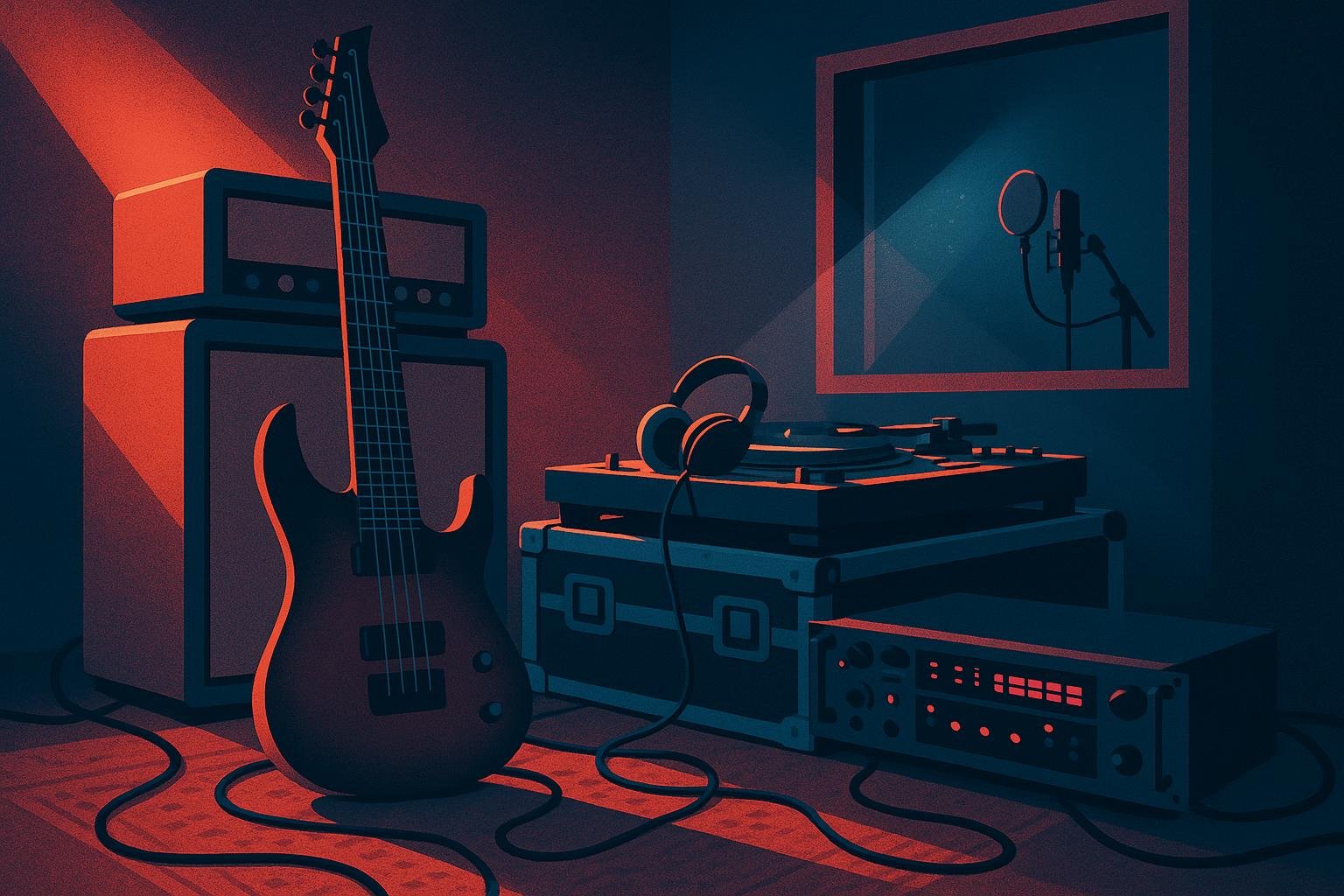
Nu-metal didn't happen by accident. A specific guitar, a specific tuning, a DJ who refused to be background noise, and a producer obsessed with subtraction combined to build a sound distinct from thrash or grunge. Here's the gear list and the exact songs where each piece first clicked into place.
The Down-Tuned Anchor: How Korn's Seven-String Guitars Rewrote Metal's Low End
Before nu-metal had a name, it had a tuning problem. Standard six-string metal riffs, even down-tuned ones, couldn't get low enough for what Korn guitarists James "Munky" Shaffer and Brian "Head" Welch were chasing. Their solution was a seventh string. Munky picked up an Ibanez Universe (UV777), Welch matched him on a seven-string of his own, and the pair dropped into what's known as A-standard tuning: ADGCFAD, a full step below regular EADGBE with an extra low string bolted underneath. Bassist Reginald "Fieldy" Arvizu answered with a five-string bass to match the low end.
That combination is all over "Blind," the opening track of Korn's self-titled debut, released October 11, 1994 on Immortal/Epic and recorded at Indigo Ranch Studios in Malibu. More than any other song, "Blind" gets the credit for launching nu-metal and popularizing seven-string guitars in metal. Limp Bizkit, who toured closely with Korn, picked up the same seven-string sound during nu-metal's late-'90s peak. Guitarist Wes Borland would drop the extra string once the trend faded.
You can hear that low-tuned grind directly on Korn's catalog: syncopated, palm-muted riffing that skips traditional metal chord shapes for something closer to a bass groove.
The Turntable Becomes a Fourth Instrument: DJ Scratches as Melody, Not Decoration
Seven-string guitars solved the low end. The next problem nu-metal solved was texture, and the answer came from hip-hop, not metal. DJ Lethal, born Leor Dimant in Riga and raised between Jersey City and Los Angeles, cut his teeth as a beatboxer before learning turntables on a friend's setup. He toured as Everlast's DJ, co-founded House of Pain, and by the late '90s had joined Limp Bizkit, where his scratching stopped functioning as an intro effect and started functioning as a hook.
That shift is clearest on "Nookie," from 1999's Significant Other. The scratches aren't a transition or a flourish between verses; they carry melodic weight the way a lead guitar line would in a straight metal song. A DJ as a novelty is one thing, a DJ as a full band member is another, and that difference is a big part of why Limp Bizkit's version of nu-metal sounds distinct from guitar-only acts like Korn.
From the Boombox to the Mic: Where Nu-Metal's Rap Cadence Came From
Nu-metal's vocal delivery, half-sung, half-rapped, built around rhythm as much as melody, didn't originate in the genre. It traces back to 1988, when Public Enemy released "Bring the Noise" on It Takes a Nation of Millions to Hold Us Back. Anthrax's rap-metal reworking of the track turned it into a direct bridge between hip-hop cadence and metal aggression, years before Korn or Limp Bizkit existed. That fusion, rapped verses landing on a metal band's riffs instead of a DJ's beat, is the direct ancestor of Fred Durst's rhythmic, half-spoken delivery in Limp Bizkit and Jonathan Davis's rap-cadence verses in Korn.
Where thrash and grunge vocalists sang or screamed over their bands, nu-metal frontmen talked over theirs, stretching syllables across the groove the way a rapper works a beat rather than a melody. It's a subtle distinction on paper. On record, it's obvious, and it's the reason nu-metal reads as hip-hop-adjacent even when the guitars are pure metal.
Subgenre Quiz
Think you know Nu Metal?
Listen to real song clips and prove it — free, no signup needed.
The Producer Behind the Curtain: Ross Robinson's Subtraction Method
Gear and vocal style only get you halfway there. Someone still has to capture it on tape in a way that sounds like nu-metal rather than generic metal. That someone was Ross Robinson. He produced Korn's 1993 demo Neidermayer's Mind and then their self-titled 1994 debut at Indigo Ranch Studios, and he went on to shape landmark records for Slipknot and Limp Bizkit as the genre exploded.
Robinson's reputation, per Metal Hammer's retrospective on his career, rests on a philosophy of subtraction rather than addition: strip a take down to its rawest, most aggressive instinct instead of layering it up. That approach shows up as dry, direct mixes with none of the reverb-soaked gloss of arena metal. Vocals sound close and unguarded. Guitars sound blunt rather than shredded. Performances sound like first takes, even when they weren't.
Eleven Years, Four Pieces
1988
Public Enemy release "Bring the Noise"
The rap track from It Takes a Nation of Millions to Hold Us Back that Anthrax would later reinterpret, planting the rap-metal blueprint nu-metal vocalists would draw from.
1994
Korn's self-titled debut
Munky and Head's seven-string, A-standard guitars, produced by Ross Robinson at Indigo Ranch Studios, give nu-metal its low end on "Blind."
1997
Limp Bizkit's Three Dollar Bill, Y'all$
DJ Lethal, formerly of House of Pain, is fully established inside the band, putting turntables alongside guitar as a lead voice.
1999
Significant Other's "Nookie"
DJ Lethal's scratching carries the song's hook rather than decorating it, cementing turntables as a genre-defining instrument.
Why This Isn't Thrash or Grunge: The Sound Ingredients Side by Side
Line the ingredients up next to metal's other major branches and nu-metal's identity gets sharper. It isn't heavier grunge or slower thrash. It swaps out specific building blocks for different ones entirely.
| Ingredient | Thrash Metal | Grunge | Nu-Metal |
|---|---|---|---|
| Guitar solos | Central, virtuosic | Occasional, loose | Rare to absent |
| Rhythmic feel | Fast, galloping tempo | Mid-tempo, dynamic swells | Syncopated hip-hop groove |
| Vocal delivery | Sung/screamed | Sung, often raw | Rap-cadence, half-spoken |
| Studio sound | Produced, high-gain | Deliberately lo-fi | Dry, stripped, produced aggression |
| Signature extra element | None | None | Turntables / DJ |
Grunge, which you can hear side by side in our Grunge quiz, leaned into lo-fi rawness almost as an aesthetic statement. Nu-metal went the opposite direction: produced and deliberate, just stripped of anything that sounded polished or happy, per Robinson's method.
Put Your Ear to the Test: The Songs That Introduced Each Element
Every element above has one song where it clicked into place first. Use this as a listening checklist:
- Seven-string, A-standard low end → Korn, "Blind" (1994)
- Turntable as a melodic instrument → Limp Bizkit, "Nookie" (1999)
- Rap-cadence vocal delivery → Public Enemy, "Bring the Noise" (1988), later reworked by Anthrax, echoed in Fred Durst and Jonathan Davis's verses
- Stripped-down, dry production → Ross Robinson's work across Korn's debut and later Slipknot and Limp Bizkit records
- Down-tuned riff you can spot by ear → Coal Chamber, "Bradley" (1997)
Put Your Ear to the Test
0/3Which Ibanez model did Korn's Munky play to help start the seven-string sound?
What's the name of nu-metal's signature down-tuning?
Which Limp Bizkit member turned turntables into a lead instrument rather than a decoration?
Subgenre Quiz
Think you know Nu Metal?
Listen to real song clips and prove it — free, no signup needed.
Frequently asked questions
What guitar tuning does nu-metal use?
Most nu-metal bands tune to A-standard, written ADGCFAD, which is standard EADGBE tuning dropped a full step with a seventh string added below for extra low end. Korn popularized it on their 1994 self-titled debut, and it became the genre's default low-end sound.
What guitar did Korn use to create the nu-metal sound?
Korn guitarist James "Munky" Shaffer played an Ibanez Universe (UV777), a seven-string model, alongside bandmate Brian "Head" Welch, while bassist Reginald "Fieldy" Arvizu used a five-string bass. That combination on 1994's "Blind" started the seven-string trend in metal.
Is nu-metal the same as rap-metal?
They overlap but aren't identical. Rap-metal specifically means rapped vocals over metal riffs, a lineage that traces back to Public Enemy's 1988 "Bring the Noise," later reworked by Anthrax into a rap-metal crossover. Nu-metal absorbed that rap cadence but added down-tuned seven-string guitars, turntables, and a hip-hop groove that thrash-descended rap-metal didn't always have.
Why doesn't nu-metal have guitar solos?
Nu-metal prioritized rhythm and groove over lead-guitar virtuosity, borrowing hip-hop's syncopated, riff-repeating structure instead of thrash metal's speed and shredding. Producers like Ross Robinson also favored raw, direct performances over polished lead breaks, reinforcing the riff-and-groove approach heard on Korn and Limp Bizkit records.
Who produced the classic nu-metal albums?
Ross Robinson produced Korn's 1994 self-titled debut at Indigo Ranch Studios and went on to shape landmark records for Slipknot and Limp Bizkit, earning a reputation for stripping arrangements down to their most aggressive, dry elements rather than polishing them.
Sources
- How KoRn Reshaped Seven-String Guitars For Nu Metal — Tedium
- Korn (album) — Wikipedia
- How Ross Robinson shaped nu metal — Louder
- DJ Lethal — Wikipedia
- 'Bring the Noise,' Public Enemy feat. Anthrax — Rolling Stone Australia
- The story behind Limp Bizkit's Nookie — Louder