The Synth Revolution: How Cheap Drum Machines and MTV Built the Sound of the 80s
Synth-pop's takeover of the charts wasn't a stylistic accident. It was a hardware story: synthesizers that only session players could afford in the 1970s suddenly got cheap, a cable channel launched with almost nothing to show, and a handful of British bands were standing in exactly the right place. This is the history of synth pop told through the machines and the records they made possible.
The synth that cost as much as a car
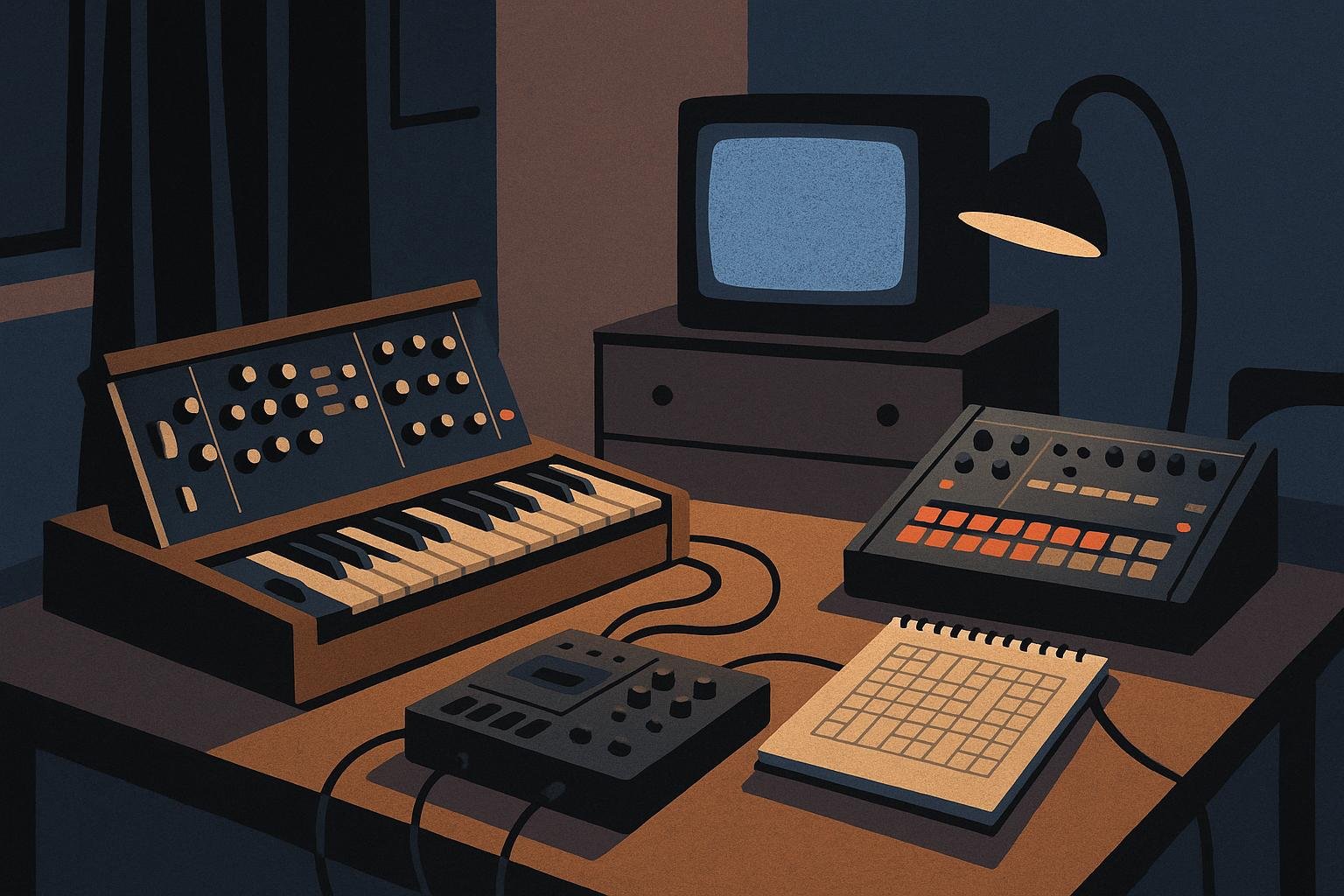
For most of the 1970s, a real synthesizer wasn't something a working band owned. It was something a studio owned. Minimoogs, ARPs and Moog modular rigs lived in the control rooms of session houses and prog-rock budgets, priced well beyond anything a gigging four-piece could justify. If you wanted that sound on a record, you booked time and hoped the session player showed up. That scarcity is why synth-pop needed a spark before it needed a scene: someone had to prove the instrument was worth chasing before the price ever came down. Jump straight into the 80s quiz or browse the wider electronic catalog, but the story of how it got affordable starts in a British recording studio in 1979.
1979: a lucky accident
Gary Numan wasn't looking for a synthesizer. He'd just signed a deal and written a stack of punk songs for his band Tubeway Army when he walked into the studio and spotted something unfamiliar sitting in the corner of the control room: a Moog Minimoog Model D, left behind by a previous session. "I just pressed a key and it made that famous Moog sound, that low growl and the room vibrated," he later told The Quietus. "It was the most powerful thing." That accident became "Are 'Friends' Electric?", built around the Minimoog's growl, and it gave Tubeway Army their first UK No. 1 single while pushing the album Replicas to the top of the UK album chart. Numan had gotten his hands on gear that almost nobody outside a studio ever touched, and it worked.
Gear to hit single: the chain of events
Through the 1970s
Studio-only luxury
Minimoogs, ARPs and Moog modulars stay out of reach for working bands — session players and major-label studios only.
1979
Gary Numan finds a Minimoog
A Minimoog Model D left in a studio control room becomes 'Are "Friends" Electric?' — Tubeway Army's first UK No. 1.
1980
Roland TR-808 launches at $1,195
Producers dismiss its drum sounds as fake. Roland discontinues it in 1983, and secondhand units crash in price.
August 1, 1981
MTV goes on air
The channel launches with almost no American videos in stock and turns to British new wave acts to fill airtime.
November 27, 1981
'Don't You Want Me' released
A borrowed Linn LM-1 lets Human League's producer swap in sampled drums; the song becomes the first UK No. 1 built on a drum machine alone.
1982
Juno-6 arrives, Second Invasion begins
Roland's Juno-6 puts real polyphonic chords under $1,300. In July, 'Don't You Want Me' tops the Billboard Hot 100 as MTV rotation carries Duran Duran and A Flock of Seagulls into the US charts.
March 1983
'Blue Monday'
New Order build the best-selling 12" single ever around an Oberheim DMX that had listed for $2,895 — the loop closes.
The drum machine that flopped its way to cheap
Roland launched the TR-808 in 1980 at $1,195, aimed at home musicians and demo studios who couldn't afford a real drummer or a real studio clock. Professional producers wrote it off almost immediately: the bass drum didn't crack like a Ludwig, the snare didn't snap like a real stick hit, and the cowbell sounded almost cartoonish. Roland discontinued the 808 in 1983, and once it fell out of production, secondhand units that had listed at over a thousand dollars became available for a small fraction of that. The same "unrealistic" sound that got it dismissed by professionals (a booming, synthetic low end nothing like an acoustic kit) is exactly what made it irresistible once it was cheap enough for anyone to own. It turned up soon after in electro and early hip-hop records, including tracks by Afrika Bambaataa and Marvin Gaye.
Roland undercuts the market
A year before the 808 crashed in price, Roland had already solved the other half of the affordability problem. The 1982 Juno-6 was a six-voice polyphonic analog synth with digitally controlled oscillators for stability, listed at around $1,295: the first quality polyphonic synth priced within reach of a band with a day job rather than a major-label advance. It lacked patch memory and MIDI, but it sounded rich and punchy, and it ended up in the hands of players like Duran Duran's Nick Rhodes and Erasure's Vince Clarke. For the first time, real chords (not just a single lead line) were something a synth-pop band could afford to tour with.
| Gear | Price | Song | Artist | Year | Chart result |
|---|---|---|---|---|---|
| Minimoog Model D | Studio-only cost, thousands of dollars | Are "Friends" Electric? | Tubeway Army | 1979 | UK No. 1 |
| Roland TR-808 | $1,195 new (1980) → a fraction of that after 1983 | N/A (adopted after price crash) | Afrika Bambaataa, Marvin Gaye | 1980s | Genre-defining hits |
| Roland Juno-6 | ~$1,295 | Studio and touring staple | Duran Duran (Nick Rhodes) | 1982 | Second British Invasion chart wave |
| Linn LM-1 | Rare, studio-only in the UK | Don't You Want Me | The Human League | 1981 | UK No. 1 / US No. 1 |
| Oberheim DMX | $2,895 (1980) | Blue Monday | New Order | 1983 | Best-selling 12" single ever |
The first drum-machine No. 1
The Human League were recording what became Dare using synthesizers to fake drum sounds, the standard workaround of the era, when their studio took delivery of one of the first Linn LM-1 drum machines in the country. That single delivery changed the album's direction: the synthetic drum facsimiles came out, and the LM-1's sampled hits went in. "Our music was so simple: we'd all laugh when Adrian Wright moved just one finger on the synthesizer and it sounded great," singer Phil Oakey told The Guardian. Released on November 27, 1981, "Don't You Want Me" became the first song to reach UK No. 1 using a drum machine exclusively for its percussion. It sold over 1.5 million copies in Britain and reportedly saved Richard Branson's Virgin label from bankruptcy. Branson was grateful enough to buy Oakey a motorbike.
The Human League - Don't You Want Me (Official Music Video) · YouTube
Decade Quiz
Think you know 80s?
Listen to real song clips and prove it — free, no signup needed.
MTV goes on air with almost nothing to play
On August 1, 1981, MTV launched in the US with a problem: almost no American act had bothered making a music video, since there was nowhere to air one. British acts, by contrast, had been building image-conscious videos for their own music shows for years. MTV had little choice but to fill its schedule with British new wave, and the very first video it aired set the tone: the Buggles' "Video Killed the Radio Star."
When a market went into heavy MTV rotation, sales by acts who'd previously had no American radio presence jumped almost immediately, and listeners started phoning stations to request songs they'd only seen on the channel.
The Second British Invasion, dated to the week
The Second British Invasion began in the summer of 1982 and peaked the following year, driven squarely by MTV's appetite for British synth-pop and New Pop. In the first week of July 1982, "Don't You Want Me" reached No. 1 on the Billboard Hot 100. That same summer, Duran Duran and A Flock of Seagulls were riding MTV's rotation into the American charts on the strength of videos, not radio adds.
Five years earlier, none of these bands could have afforded the instruments powering their breakthrough. For more on how gear reshaped pop across the decades, there's a broader look at how technology rebuilt pop music, plus dance and britpop quizzes for the sounds that followed.
Did the history stick?
0/3What was the Roland TR-808's original 1980 launch price?
What made Human League's 'Don't You Want Me' chart history in the UK?
Why did MTV lean so heavily on British acts when it launched in August 1981?
Blue Monday and the $2,895 machine
By 1983, New Order (the band that rose from Joy Division's ashes) were deep into the synth-driven evolution captured on "Age of Consent," from that year's Power, Corruption and Lies.
That same year, New Order built "Blue Monday" around an Oberheim DMX, a digital drum machine that had listed for $2,895 when it launched in 1980: more than double what the TR-808 cost new, and nowhere near pocket change for an independent band on Factory Records. The song went on to become the best-selling 12" single in history, six years after Numan stumbled onto a Minimoog left behind in a studio control room and proved the gear was worth chasing in the first place.
Decade Quiz
Think you know 80s?
Listen to real song clips and prove it — free, no signup needed.
Frequently asked questions
Why was the Roland TR-808 dismissed by producers when it launched?
When the TR-808 launched in 1980 at $1,195, engineers complained its analog percussion didn't sound like a real kit: the bass drum didn't crack like a Ludwig and the snare didn't snap like a real stick hit. That same synthetic character later became its signature sound in electro and hip-hop once the price collapsed.
What synthesizer started synth-pop's chart breakthrough?
A Minimoog Model D that Gary Numan found abandoned in a studio control room while recording with Tubeway Army in 1979. He built 'Are "Friends" Electric?' around it, and the song became the band's first UK No. 1.
What was the first song to hit UK No. 1 using only a drum machine?
The Human League's 'Don't You Want Me,' released November 27, 1981. A borrowed Linn LM-1 let producers replace the album's synthesized drum facsimiles with sampled ones, and the song went on to sell over 1.5 million copies in the UK.
How did MTV help start the Second British Invasion?
MTV launched on August 1, 1981 with almost no American music videos in its library, since US acts rarely made them. It filled airtime with British new wave and synth-pop videos out of necessity, and that rotation carried acts like Duran Duran and A Flock of Seagulls onto the US charts by 1982.
What made New Order's 'Blue Monday' a turning point for synth-pop?
Built around an Oberheim DMX drum machine that had listed for $2,895 in 1980, 'Blue Monday' became the best-selling 12" single of all time, evidence that gear once reserved for major-label budgets could now drive a mass-market hit.
Sources
- How Gary Numan's discovery of the Minimoog inspired The Pleasure Principle — and the birth of synth-pop — MusicRadar
- Roland TR-808 Drum Machines (1980-1983) — Specs & History — Vintage Technology Archive
- Roland Juno-6 — Vintage Synth Explorer
- Replicate the sonic magic of the Human League's defining synth-pop anthem — MusicRadar
- Second British Invasion — Wikipedia
- Oberheim DMX — Wikipedia