The History of Pop Music: How Six Decades of Technology Rebuilt What 'Pop' Sounds Like
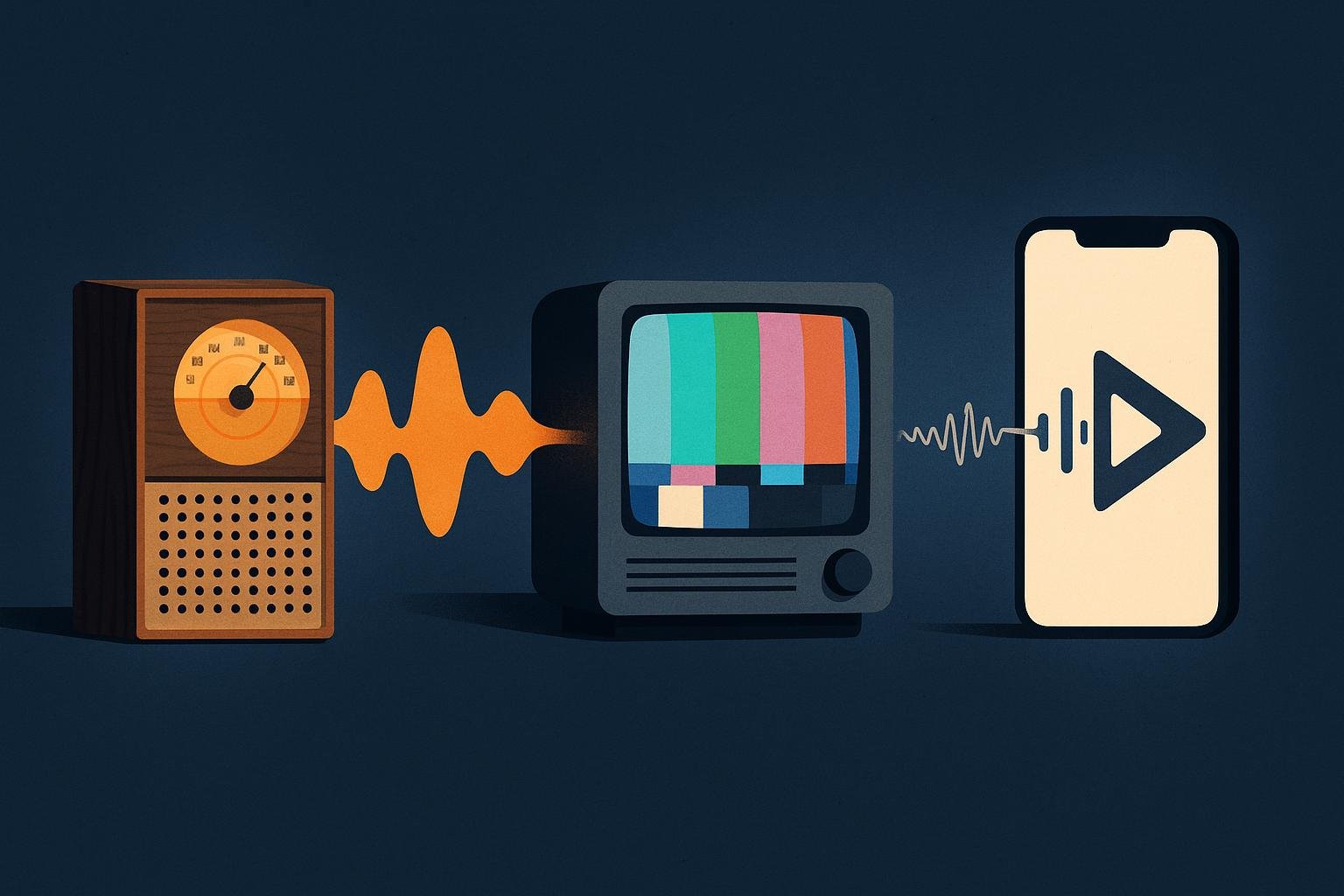
Ask what shaped pop music and you'll get opinions about eras and idols. But the real story of pop music evolution is mechanical: a chain of technologies — AM radio, Motown's assembly line, MTV's cameras, Napster's servers, streaming's algorithm — that each rebuilt what a hit song had to sound like, and how fast it had to grab you.
Search "history of pop music" and you'll mostly get taste: best decades, best divas, best one-hit wonders. What actually built pop's history is less romantic and more mechanical: a chain of technologies that each forced the music to change shape. Radio decided how long a song could be. A record label engineered hits to survive a car speaker. A cable channel decided a singer also had to be a performer on camera. A file-sharing app broke the industry's entire business model. And now a skip button decides how fast a song has to earn your attention. Follow that chain and pop's evolution stops looking like a matter of opinion and starts looking like a matter of infrastructure.
70 Years of Pop, by Technology
1950s
Radio Builds the Formula
AM radio's limits set the template: a short, hook-forward single that grabs listeners in seconds.
1959
Motown Is Founded
Berry Gordy opens Hitsville U.S.A. in Detroit and engineers records to cross over on mainstream radio.
1981
MTV Goes on Air
August 1: pop becomes a visual medium overnight.
1983
Thriller Resets the Ceiling
A $500,000, 14-minute short film cements the music video as an art form.
1999
Napster Peaks
U.S. recorded music sales hit $14.6 billion, then begin their long slide as free file-sharing spreads.
2001–2010s
Downloads, Then Streaming
Paid digital sales and services like Spotify, Apple Music and YouTube become the new distribution layer.
2020s
The Skip-Button Era
Streaming's skip button and payout thresholds rewire how songs are written, from intro to hook.
Radio Made Pop a Formula
Before anyone could stream, download, or even flip to MTV, pop music had exactly one delivery system: AM radio. That system had hard technical constraints, and those constraints became the definition of a "pop song." Airtime was scarce and shared across dozens of songs an hour, so a single had to say what it needed to say fast — no minutes-long instrumental throat-clearing, no waiting around for the hook. A song had to grab a listener in the first few seconds or lose them to the dial.
That's the world a song like the Beatles' "Hey Jude" was built for, and in some ways pushed against: an enormous, communal singalong hook wrapped around a pop single, made to fill a jukebox slot and a radio format at the same time.
That radio-shaped formula became the baseline every later technology would disrupt, starting with a label that understood radio's rules better than anyone.
The Motown Machine
Berry Gordy founded Motown Records in Detroit on January 12, 1959, with an $800 loan from his family (about $8,600 today). Gordy had worked the production line at a Lincoln-Mercury plant, and he rebuilt that assembly-line logic inside "Hitsville U.S.A.," his Detroit headquarters: everyone who walked in, from singers to secretaries, was expected to contribute to the music.
Between 1961 and 1971, Motown landed 110 Billboard Top Ten hits, powered by acts like The Temptations, The Supremes, Stevie Wonder, Marvin Gaye and The Jackson 5. Smokey Robinson later said Motown succeeded by "breaking down barriers with music," reaching Black and white audiences alike, in the U.S. and worldwide.
The secret was engineering, not just songwriting. Motown's "Motown Sound" fused gospel call-and-response with jazz syncopation, tambourines, blaring horns and foot-slapping drums. Chief engineer Mike McClain then ran finished mixes through a small, tinny "radio box" built to mimic exactly how a song would sound coming out of a car radio. If it still hit on that cheap little speaker, it was ready. Motown wasn't guessing what pop should sound like; it was reverse-engineering the format. Songwriting teams like Holland-Dozier-Holland and the in-house band the Funk Brothers turned that formula into hit after hit, and by 1964 the label had even built an Artist Personal Development Department to coach performers on stage presence, proof that Motown treated pop stardom as something you could manufacture on purpose. If you want to hear where that machine's DNA still lives, play the R&B / Soul quiz and see how many hits you can name.
Video Killed the Radio Star
On August 1, 1981, a cable channel called MTV went on the air for the first time, opening with the line, spoken by co-creator John Lack: "Ladies and gentlemen, rock and roll." The first video it played was, fittingly, the Buggles' "Video Killed the Radio Star." MTV was tiny at launch (available only in parts of New Jersey) and ran on free music videos supplied by record labels, introduced by on-air VJs.
That upended what it took to be a pop star. Radio had only ever demanded a great voice and a tight arrangement. MTV demanded a face, a body, a performance. Artists who translated well on camera (Madonna, Michael Jackson, Prince, Duran Duran) went into heavy rotation and became the decade's defining stars. Artists who didn't have that visual instinct suddenly had a real disadvantage they'd never faced on radio alone.
One of the acts that thrived in that new visual era of pop was Dexys Midnight Runners, whose fiddle-driven, dungaree-clad "Come On Eileen" became inseparable from its MTV-era video image.
Genre Quiz
Think you know Pop?
Listen to real song clips and prove it — free, no signup needed.
Thriller and the Short-Film Pivot
Two years after MTV launched, Michael Jackson blew the ceiling off what a music video could be. "Thriller," released in December 1983 and directed by John Landis, cost more than half a million dollars and ran nearly 14 minutes: less a video than a short horror film, complete with Vincent Price narration, a full monster cast, and a plot. Jackson starred in it, and co-produced, co-wrote and co-choreographed it too.
Michael Jackson - Thriller (Official 4K Video) · YouTube
The Thriller album produced seven Top 10 hits, held No. 1 on the Billboard 200 for an unprecedented 37 weeks, and has sold more than 29 million copies in the U.S. alone. The title track won Jackson a Grammy for Best Pop Vocal Performance, Male, part of a haul of seven Grammys that year. In 2009, the Library of Congress made "Thriller" the first music video ever added to the National Film Registry. It also did something structural to the industry: it proved a music video could justify a real filmmaking budget, and it showed MTV, then only two years old, was now the platform every ambitious pop act had to master.
Napster and the Digital Fracture
By the late 1990s, pop's technology-driven story took a violent turn. In 1999, U.S. recorded music sales peaked at $14.6 billion, according to RIAA data. That same year, a free file-sharing service called Napster exploded in popularity, letting fans download music without paying for it. A 2001 federal court ruling found Napster liable for encouraging mass copyright infringement and effectively shut it down, but the damage to the industry's business model was already done. By 2014, U.S. recorded music sales had fallen to just $6.97 billion, less than half their 1999 peak.
The old model (physical sales driven by radio exposure) simply couldn't survive an internet where music could be copied for free at scale. The RIAA pursued lawsuits against individual downloaders, a bruising and unpopular strategy, because, as one RIAA spokesperson put it, Napster and the services that followed it "had no interest in going legit or following the law." Pop's next era would have to be built on a completely different foundation: a legal way to buy music digitally, one song at a time.
From Downloads to the Feed
That legal foundation arrived through paid digital downloads, which gave the industry a way to monetize the internet instead of fighting it. It worked well enough that by 2014, physical and digital sales had reached parity for the first time, each about 46% of industry revenue, according to the IFPI. But downloads were only a bridge. Streaming was the destination: services like Spotify, Apple Music and YouTube began pulling in listeners who, according to the IFPI, "weren't in the licensed music environment before," and streaming was already forecast to overtake downloads the following year.
The shift mattered beyond revenue. Radio had been pop's gatekeeper for 70 years, then MTV, then, briefly, the record store's new-release wall. Streaming replaced all of them with a recommendation algorithm: a gatekeeper with no format clock and no regional limits, capable of turning a Spanish-language single like Luis Fonsi's "Despacito" into a genuinely global, multi-year phenomenon in a way pre-internet pop distribution never allowed.
Curious how far pop's sound has traveled since the streaming shift? The Electronic quiz is a good next stop for hearing where algorithmic-era production heads next.
| Turning Point | The Number | Why It Mattered |
|---|---|---|
| Motown (1961-1971) | 110 Billboard Top Ten hits | Proved pop hits could be engineered, not just written |
| Thriller (1983) | 37 weeks at No. 1; 29M+ US copies sold | Made the music video a legitimate art form worth real budget |
| Napster shock (1999-2014) | US recorded music revenue fell from $14.6B to $6.97B | Ended the physical-sales business model for good |
| Streaming-era intros (mid-1980s vs. 2015) | Average intro length fell from ~20 seconds to ~5 seconds | Rewrote song structure around the skip button |
The Skip-Button Song
Streaming changed how pop gets paid for. It changed how pop gets written too. Researcher Hubert Léveillé Gauvin at Ohio State analyzed Billboard Top 10 hits from 1986 to 2015 and found a dramatic structural shift: instrumental intros that averaged more than 20 seconds in the mid-1980s had shrunk to about 5 seconds by 2015. Song titles got shorter too, trending toward one-word "wonders," and once a song's vocals started, it took roughly 18% less time to reach the first hook. Average tempo climbed about 8% over the same period.
The cause, per Léveillé Gauvin, is what he calls the "attention economy" of streaming: on a platform where skipping costs a listener nothing, "songs that manage to grab and sustain listeners' attention get played and others get skipped. There's always another song." That single mechanic (the skip button, and the payout thresholds streaming services build around it) has done more to reshape pop songwriting in the last decade than any single artist or trend. Bridges shrink or disappear. Solos vanish. The title lands in the first line. It's the same story as radio's 3-minute single or Motown's radio box: the format writes the rules, and the songs follow.
Test What You Just Learned
0/3Motown's chief engineer built a tinny 'radio box' to test new mixes. What was he simulating?
What channel launched on August 1, 1981, turning pop into a visual medium?
Research on Billboard Top 10 hits found average song intros shrank from the mid-1980s to 2015. By how much?
Hear the Decades for Yourself
Radio's format, Motown's radio box, MTV's camera, Napster's shockwave and streaming's skip button each rewrote what a pop song had to sound like, and each rewrite left fingerprints on the songs themselves.
Test your ear against the eras: the Pop quiz mixes tracks across all of these turning points. See how many decades you can identify by sound alone.
Genre Quiz
Think you know Pop?
Listen to real song clips and prove it — free, no signup needed.
Frequently asked questions
What is the history of pop music, in short?
Pop's history is really a history of its distribution technology. AM radio forced songs into a short, hook-first format; Motown engineered records for the way they'd actually sound on the radio; MTV turned pop into a visual medium in 1981; Napster's file-sharing wave collapsed the old sales model after 1999; and streaming now rewards songs that hook listeners before they hit skip. Each shift changed what a 'pop song' had to sound like.
How did Motown shape modern pop music?
Berry Gordy founded Motown in Detroit on January 12, 1959, and ran it like the auto assembly lines he'd worked on, producing 110 Billboard Top Ten hits between 1961 and 1971. Engineer Mike McClain built a tinny 'radio box' to test mixes the way they'd sound on a car radio, ensuring every Motown record was engineered to cross over on mainstream stations.
When did MTV launch and why did it matter to pop music?
MTV launched on August 1, 1981, opening with the Buggles' 'Video Killed the Radio Star.' It turned pop from a purely audio format into a visual one almost overnight, making video presence, not just vocal ability, part of what it took to become a pop star.
How did Napster affect the music industry?
Napster's free file-sharing exploded in 1999, the same year U.S. recorded music sales peaked at $14.6 billion. After a 2001 federal court ruling shut Napster down for enabling mass copyright infringement, the industry never recovered its old revenue: sales had fallen to $6.97 billion by 2014, forcing the shift to paid downloads and, eventually, streaming.
How has streaming changed the way pop songs are written?
Because streaming platforms let listeners skip a song at any second, songwriters now front-load the hook. Research on Billboard Top 10 hits found average intro length shrank from over 20 seconds in the mid-1980s to about 5 seconds by 2015, tempo rose roughly 8%, and song titles got shorter as artists raced to grab attention before the skip button gets pressed.
Sources
- The Sound that Changed America: The History of Motown — Houston Symphony
- MTV launches — HISTORY
- Michael Jackson's "Thriller": MTV's Watershed Moment — Recording Academy / GRAMMY.com
- After Napster, the music industry winds up humming — CBS News
- Has music streaming killed the instrumental intro? — Ohio State University News