How to Pick a Karaoke Song That Actually Kills (For Every Type of Crowd)
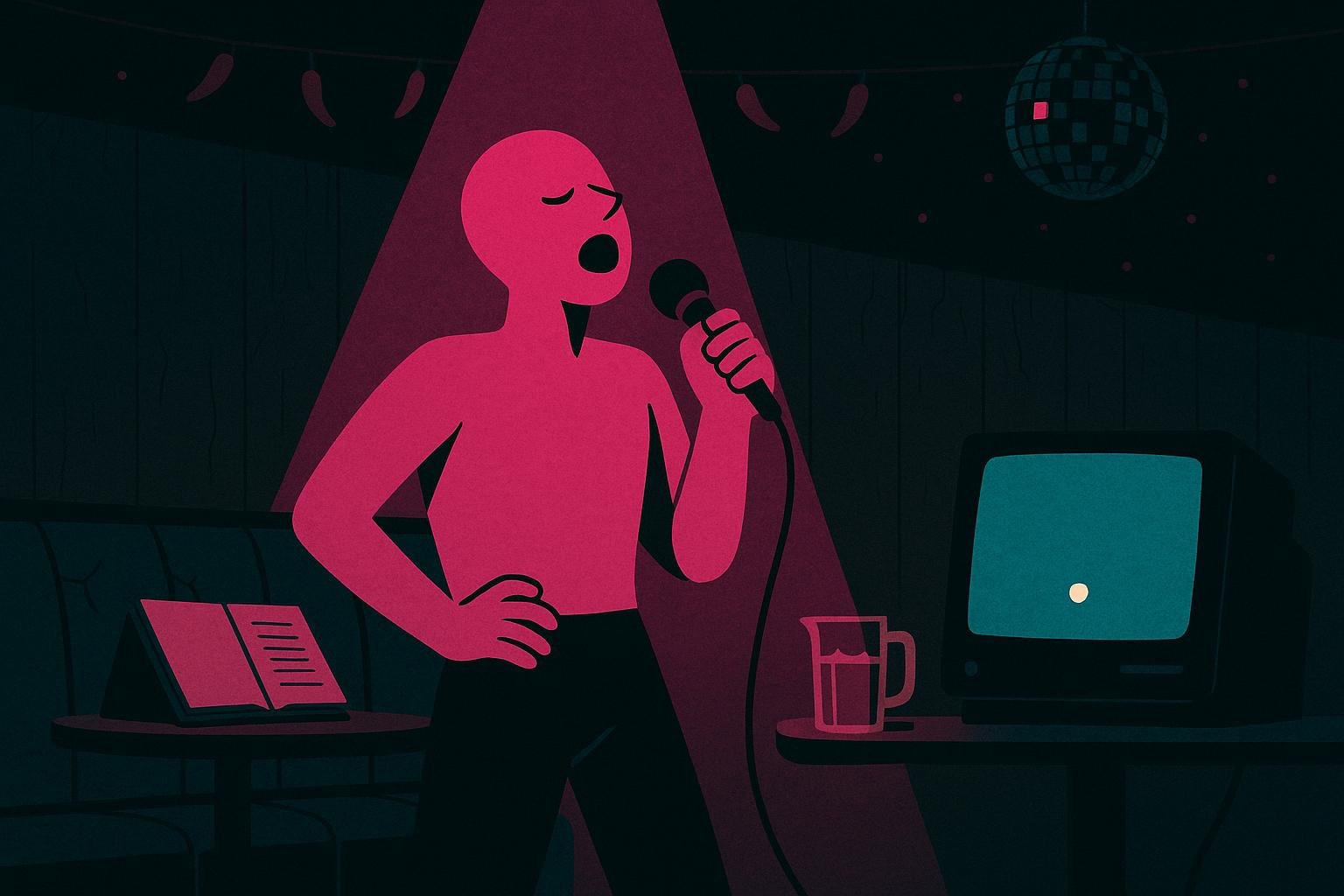
The right karaoke song isn't the one you sing best — it's the one that fits the room. A dive bar rewards personality, an office party punishes anything risky, a wedding after-party wants three generations dancing at once, and a tourist bar just needs instant recognition. Here's how to read the crowd and queue accordingly.
Read the Room Before You Read the Songbook
The biggest mistake in karaoke has nothing to do with your voice. It's picking a song for yourself instead of for the room. Before you flip a single page of the songbook, four fast signals already tell you what's going to land: the age spread in the crowd, how full the floor already is, how many rounds the room has been drinking through, and the gap between a hushed listening bar and a party bar where nobody's really watching the stage.
Research summarized by the National Institutes of Health and cited by Gigwise found that people who sing together report a stronger sense of belonging than people who sing solo. That's why a packed, participating room feels like a different event than three people nursing drinks in silence. Your job with any pick is to trigger that group moment, not to show off. See how to pick a karaoke song for a real crowd, or, if you'd rather match a song to your own range, our guide to picking karaoke songs by voice type.
The Dive Bar Regulars
A dive bar karaoke night runs on a small, loyal cast who have clocked every regular's go-to song the way they've clocked their usual seat. This crowd doesn't want polish. They want personality, and they'll forgive a rough vocal if the story lands. Gigwise's list of the most-requested karaoke staples leans hard into exactly this lane: Billy Joel's "Piano Man," Don McLean's "American Pie," and Frank Sinatra's "My Way" all work because they're built around narration and character, not vocal fireworks.
The unwritten rule here is social, not musical: don't queue the song that belongs to somebody else. If a regular has sung "Sweet Home Alabama" every Thursday for two years, requesting it yourself reads as a challenge, not a tribute. Pick something adjacent to the room's classic-rock or singer-songwriter comfort zone (our Rock quiz is a decent gut check for how deep that catalog runs) and let the regulars carry the chorus.
The Office Party
Office karaoke is a minefield disguised as team building. Lalal.ai's rundown of work-safe songs gets the formula right: clean language, positive themes, and tracks that are culturally recognizable enough that nobody has to fake familiarity. ABBA's "Dancing Queen," Earth, Wind & Fire's "September," and Whitney Houston's "I Wanna Dance with Somebody" all clear that bar. They're upbeat and inclusive, and nobody's going to hear them as a statement about anyone in the room.
The backfire risk rarely comes from an obscure pick. It comes from content nobody flagged as risky until it's already playing. Vice's survey of karaoke bartenders singled out Kanye West's "Gold Digger" for exactly this reason: the crowd-pleaser reputation ignores that its most memorable lyric puts singers in a genuinely bad spot in front of coworkers. A crowd-pleaser karaoke song for a work event has to be safe on a second listen, not just catchy on the first.
The Wedding After-Party
A wedding after-party is the one room built to actually reward a big swing. The floor is already primed, and the crowd spans three generations who rarely share a playlist any other night of the year. Greenlight Booking's list of wedding karaoke staples nails why Neil Diamond's "Sweet Caroline" works so reliably: the "bum, bum, bum" call-and-response needs zero preparation, so even guests who claim they don't sing end up shouting the hook. Journey's "Don't Stop Believin'" works the same way, built to "pack the dance floor" across age gaps, per the same source. Though see the traps section below for why it's riskier than its reputation suggests, once the room's heard it a hundred times before.
Dexys Midnight Runners' 1982 hit "Come On Eileen" belongs in the same category: a tempo shift built right into the arrangement that turns a singalong into a genuine dance move, recognizable to grandparents and groomsmen alike.
If you're building out the rest of the reception rather than just the karaoke slot, our piece on sequencing a wedding reception playlist moment by moment picks up exactly where this leaves off. And if country-leaning relatives are half the guest list, our Country quiz is worth a scan for backup picks.
Genre Quiz
Think you know Pop?
Listen to real song clips and prove it — free, no signup needed.
Strangers at a Tourist Bar
This is the purest version of the problem: a room with no shared history, no inside jokes, no regulars to read. Recognition and brevity have to do all the work, because there's no goodwill to fall back on if the song runs long or drags.
That's exactly why Smash Mouth's "All Star" earns its permanent spot on karaoke nights everywhere strangers gather. Nobody needs range to deliver it, the hook lands within the first fifteen seconds, and it's short enough that even a shaky performance is over before the room loses interest. It's a song engineered for pure recognition over polish, the opposite priority from the dive bar's personality-first crowd.
The Famous Traps: Beloved Songs That Clear the Floor
When Billboard polled its 100 best karaoke songs of all time, the #1 pick was neither Queen nor Prince: it was Shania Twain's "Man! I Feel Like a Woman!," ahead of the Backstreet Boys' "I Want It That Way" and Gloria Gaynor's "I Will Survive." Queen's "Bohemian Rhapsody" landed at #4. But there's a gap between ranking well on a list and playing well tonight, in the specific room you're standing in. That gap is where these famous traps live.
"Bohemian Rhapsody" (Queen). One bartender surveyed by Vice put it bluntly: "Anything by Whitney Houston or Queen. No one and I mean NO ONE has a good enough voice to sing those." The song's operatic range and six-minute runtime mean it gets butchered nightly by singers who requested it for the reputation, not the difficulty.
"Don't Stop Believin'" (Journey). A different bartender called it out for the opposite problem, overfamiliarity: "It's the one song every drunk person thinks they know every word to and can sing flawlessly and just stop already." The song's fine. The room's just heard it too many times this month.
"Hey Jude" (The Beatles). As one bartender asked Vice: "Can we not nah nah nah for 18 bars?" The extended outro is the structural problem: a song with no clean ending drags a crowd's attention past the point it was ready to move on.
"Zombie" (The Cranberries). Drunk singers reach for it thinking it reads as edgy, but per Vice, it's "way more overdone than you think" and mostly reveals "just how much they can sound like a screaming goat," a vocal chase built around one very specific, very tired voice.
Your Cheat Sheet for Tonight
| Crowd / Venue | Song that lands | Why it works | Trap to avoid |
|---|---|---|---|
| Dive bar regulars | "Piano Man" by Billy Joel | Story-driven, forgives a rough voice, rewards personality over polish | A regular's signature song: it reads as a challenge, not a tribute |
| Office party | "Dancing Queen" by ABBA | Clean, upbeat, recognizable to nearly any age or taste | "Gold Digger": its most memorable lyric puts coworkers in a bad spot |
| Wedding after-party | "Sweet Caroline" by Neil Diamond | Call-and-response chorus needs zero prep, bridges three generations | Any slow ballad: it stalls a floor that's already dancing |
| Tourist bar strangers | "All Star" by Smash Mouth | Instant recognition, short runtime, no shared history required | Deep cuts or personal ballads nobody in the room will know |
Did You Read the Room?
0/3Which song topped Billboard's list of the 100 best karaoke songs of all time?
Per bartenders surveyed by Vice, why does 'Don't Stop Believin'' wear a room out instead of winning it over?
Listen to this clip. Structurally, it's the safer queue for which crowd?
If the Room Isn't Biting
Sometimes you read the signals right and the song still doesn't land. That's a recovery problem, not a reason to panic. Watch for the tell mid-song: phones coming back out, conversations restarting at the bar, the floor thinning instead of filling. That's your cue to correct, not to double down with something bigger or more dramatic to win the room back.
The fix is almost always to go smaller and safer, not louder: shorter runtime, more familiar hook, easier tempo to move to. If the miss was about pitch rather than crowd fit, that's a different fix. Check our guide to picking karaoke songs by voice type for that half of the equation. And if the room simply wants recognition over risk, an upbeat pop standard is almost always the safest reset.
Genre Quiz
Think you know Pop?
Listen to real song clips and prove it — free, no signup needed.
Frequently asked questions
What is the single best karaoke song for a crowd you don't know?
Pick for recognition and brevity, not vocal difficulty. A song like Smash Mouth's "All Star" works because nearly everyone can sing along from the first line, it doesn't demand range, and it's over before the room's attention drifts. Save personal or deep-cut choices for a room that already knows you.
Why does 'Bohemian Rhapsody' clear the floor instead of packing it?
It ranks near the top of Billboard's best-karaoke-songs list on paper, but in practice it demands an operatic range almost no karaoke singer has, runs over five minutes, and gets requested so often that some bars now charge a fee for it. Great song, bad structural fit for a live room waiting on you.
What karaoke songs are safest for an office party?
Clean, widely recognized, upbeat tracks work best: think ABBA's 'Dancing Queen,' Earth, Wind & Fire's 'September,' or Whitney Houston's 'I Wanna Dance with Somebody.' Avoid anything with slurs or lyrics that put a coworker in an awkward spot to sing along, even if the song itself is a certified classic.
What's the best karaoke song for a wedding after-party?
Songs built to bridge generations in one chorus: Neil Diamond's 'Sweet Caroline' and Dexys Midnight Runners' 'Come On Eileen' both work because grandparents, parents, and the wedding party's friends all know the words at the same moment, and the tempo keeps a floor that's already dancing on its feet.
The room went cold mid-song. What do I queue next?
Don't double down with something bigger or more dramatic. Read what killed the energy (too slow, too obscure, too long) and correct for exactly that: shorter, more familiar, more danceable. A quick recovery pick restores momentum faster than an apology.
Sources
- Billboard's #1 Best Karaoke Song Ever Isn't Queen, Isn't Prince, But Is... — CBS News Minnesota
- The Karaoke Songs We Need to Stop Singing, According to Bartenders — Vice
- 60 Best Karaoke Songs for Weddings That Keep Parties Alive! — GreenLight Booking
- Top Safe Karaoke Songs for Work Events: Boost Team Spirit — LALAL.AI
- 111 Karaoke Songs to Always Get the Crowd Singing — Gigwise