Classical Music's Composer Timeline: From Hildegard of Bingen to the Film Scores You Hear Today
Most classical composers timeline pages read like a syllabus. This one is built for your ears: four audible turning points — Josquin's polyphony, Haydn's symphony form, Mahler's orchestral scale, and Wagner's leitmotif — that let you place almost any piece of classical music, or any film score, into its correct era on the first listen.
Hildegard of Bingen and the first named voice
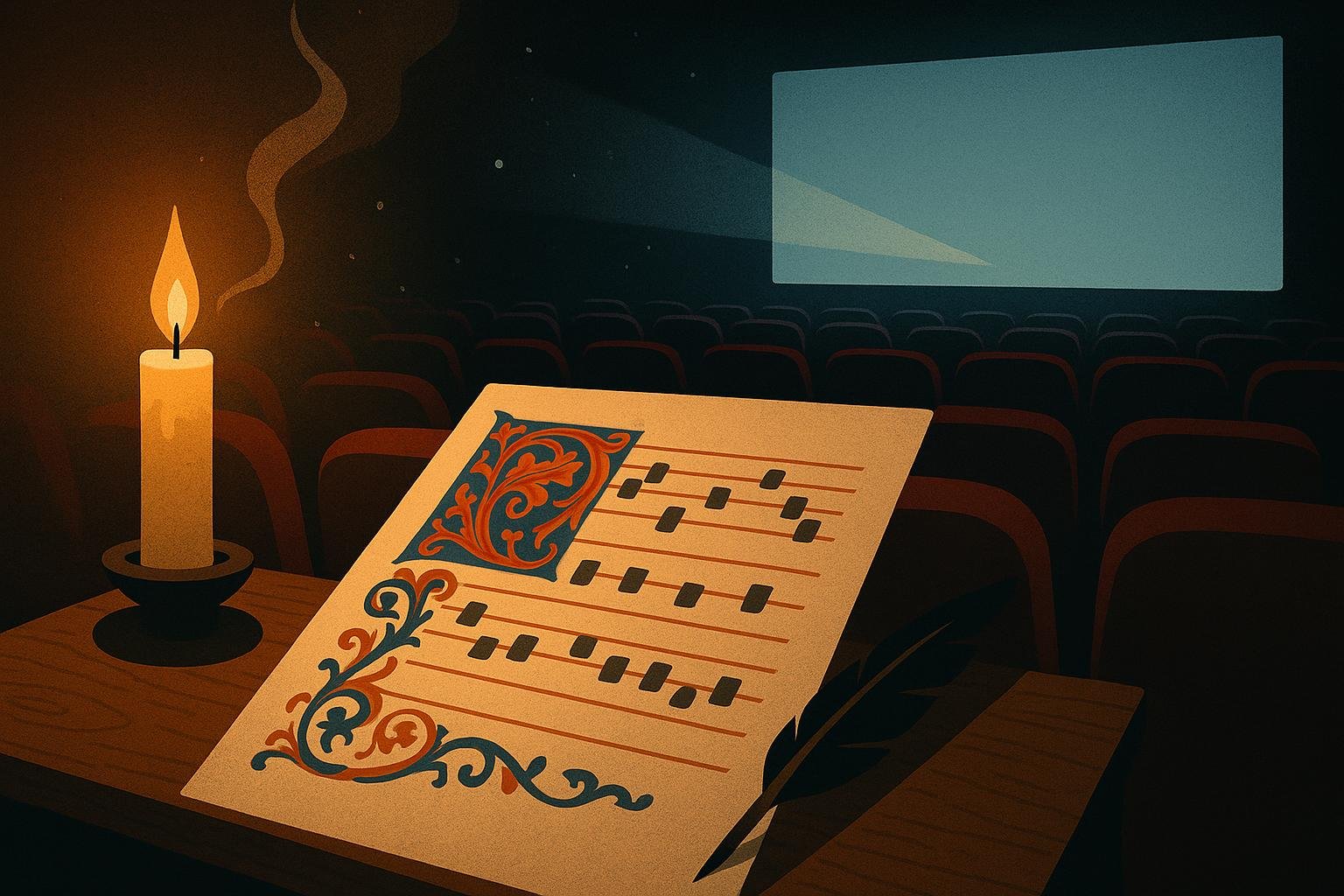
For centuries, church music was communal and anonymous. Chant belonged to the liturgy, not to an author. Then came Hildegard of Bingen (1098-1179), a German abbess, visionary, and self-taught polymath who stood up to monks, bishops, popes, and emperors across Europe and still found time to compose. Her music is monophonic plainchant: a single unaccompanied melodic line, no harmony stacked underneath it, no second voice answering it. Hildegard is one of the first composers whose name survives attached to specific music, the point where music history starts tracking individuals instead of traditions. Everything that follows here is what got added on top of that single line.
Josquin des Prez and the Renaissance leap into polyphony
Fast-forward roughly three centuries and the single line splits into several. Josquin des Prez, born around 1450-55 and active until his death in 1521, became the most celebrated composer of the Franco-Flemish school by mastering polyphony: multiple independent melodic lines moving at once, each imitating and answering the others rather than one voice simply carrying a tune with accompaniment underneath. His motet Ave Maria … Virgo serena and masses like Missa Pange Lingua built entire structures out of a technique called imitation, where one voice states a melodic idea and the next voice repeats it a few beats later, layering the texture as it goes. This is the first turning point an untrained ear can actually catch: if you hear several melodic lines chasing each other rather than one melody with backing, you're almost certainly in Renaissance territory, sometime between about 1480 and 1521.
Bach and the Baroque architecture of counterpoint
Josquin's imitation became Johann Sebastian Bach's architecture. Bach (1685-1750) spent his career moving through German court and church posts: Arnstadt, Mühlhausen, and crucially Weimar starting in 1708, where he worked first as organist and then as concertmaster, before later posts at Cöthen and, from 1723, Leipzig. Across that arc he turned counterpoint (layered, interweaving voices that are harmonically and rhythmically independent yet lock together) into the defining texture of the Baroque era. His mastery of harmony, counterpoint, and form made him one of the central figures in Western music, even though he received little recognition in his own lifetime. Bach's counterpoint is the direct ancestor of film-score writing: multiple musical ideas moving at once toward a single, inevitable-sounding resolution, the same trick a modern composer uses to make tension and release feel unavoidable.
If you want to hear Baroque counterpoint at its most immediately recognizable, Bach's Air on a G String is the textbook case: a single singing melody riding over a steadily moving bassline, with the inner voices filling in the architecture underneath.
Haydn, Mozart and the invention of symphonic drama
Counterpoint builds texture; sonata form builds narrative. Roughly between 1760 and 1800, Joseph Haydn and Wolfgang Amadeus Mozart established sonata form as the backbone of the Classical era symphony: an exposition that lays out contrasting musical themes, a development section that pulls those themes apart and puts them through harmonic tension, and a recapitulation that resolves everything back into the home key. Where Baroque counterpoint layers voices to build density, sonata form organizes time to build drama: a beginning, a complication, and a resolution, inside a single movement. It's the structural skeleton that virtually every symphony, concerto, and sonata written afterward still leans on in some form.
Rondo Alla Turca, from Sonata Kv 331
Wolfgang Amadeus Mozart · 2026
Mozart's Rondo alla Turca shows the Classical era's other hallmark alongside sonata form: clarity. Themes are stated plainly, developed with wit rather than density, and resolved cleanly: the opposite impulse from Bach's layered counterpoint, just as audible once you know to listen for it.
Subgenre Quiz
Think you know Classical?
Listen to real song clips and prove it — free, no signup needed.
Beethoven's rupture and the Romantic swell to Mahler
Beethoven took Classical form and broke its proportions. Across roughly 1800 to 1911 (from Beethoven's symphonies through to Gustav Mahler's death in that year), composers expanded nearly every dimension of the orchestra at once: more brass, more percussion, longer movements, and a much more personal, emotionally extreme musical language than Classical-era convention allowed. This is the third audible turning point: Romantic music got bigger on purpose, built to overwhelm a listener rather than simply satisfy formal expectations. Mahler's symphonies, requiring enormous orchestral forces and running well over an hour in some cases, are the outer edge of that expansion: orchestral scale as its own expressive tool.
The hand-off to Hollywood
Richard Wagner's Ring cycle, dissonant and dramatic for its time, is the original "cinematic" composition: its Romantic vocabulary became the basic toolbox for a century's worth of film composers. The device Wagner is best known for is the leitmotif: a distinctive musical identity for a character or idea, reshaped and recombined as the story develops. John Williams, Juilliard-trained and already an Academy Award winner for Jaws by the time he scored Star Wars in 1977, built the entire Star Wars musical universe on exactly that device, filtered also through the orchestral color of composers like Tchaikovsky.
John Williams - Star Wars Main Title - Boston Pops · YouTube
The Ride Of The Valkyries
The Royal Philharmonic Orchestra · 2007
Put Wagner's Ride of the Valkyries next to the Imperial March and the lineage is unmistakable: same brass weight, same function: announcing power before you see it on screen. This same Romantic-to-cinematic DNA runs through more than just Star Wars: you'll hear it in horror scoring, anime soundtracks, and video-game themes across the Classical / Soundtrack catalog, and occasionally even in the orchestral flourishes that turn up in modern Electronic production.
Placing any piece by ear
You now have four checkpoints that work on almost anything you hear, concert hall or movie theater alike.
| Turning point | Composer | Period | What to listen for |
|---|---|---|---|
| Polyphony | Josquin des Prez | c. 1480-1521 | Multiple melodic lines imitating each other, no single lead |
| Counterpoint | J.S. Bach | 1708-1750 | Dense, interweaving voices building toward one resolution |
| Sonata form | Haydn & Mozart | c. 1760-1800 | A theme stated, pulled apart, then resolved — drama inside structure |
| Orchestral scale & leitmotif | Beethoven to Mahler, then Wagner | c. 1800-1911 | Huge forces, personal intensity, recurring character themes |
Run any unfamiliar piece through that checklist: one voice or several, light texture or dense counterpoint, modest ensemble or massive one, a recurring character theme or none, and you can place it within a few decades without knowing the composer's name.
Ready to test it against real recordings instead of a table? The Classical quiz plays 30-second clips spanning Hildegard's descendants all the way to Williams'. See how many eras you can place before the next clue drops.
Subgenre Quiz
Think you know Classical?
Listen to real song clips and prove it — free, no signup needed.
Frequently asked questions
Who is considered the first named composer in Western music history?
Hildegard of Bingen (1098-1179), a German abbess, is one of the first composers whose name and music survive together. Before her, plainchant was largely anonymous and communal; her monophonic compositions are among the earliest attributed to a specific individual.
What's the difference between Renaissance polyphony and Baroque counterpoint?
Josquin des Prez (c. 1450/55-1521) pioneered Renaissance polyphony, where multiple independent vocal lines imitate and answer each other in masses and motets. Bach (1685-1750) inherited that technique and built it into dense instrumental counterpoint: fugues and cantatas where interweaving voices create harmonic architecture, not just imitation. Counterpoint is polyphony taken to structural extremes.
Why does sonata form matter so much in the Classical era?
Haydn and Mozart, working roughly between 1760 and 1800, built symphonic movements around an exposition-development-recapitulation shape: themes are introduced, pulled apart and reworked, then resolved. That three-act structure gave instrumental music a sense of drama and journey that Baroque forms hadn't emphasized, and it became the template nearly every symphony after them used.
How did Beethoven and the Romantics change the orchestra?
Beethoven's later symphonies pushed emotional scale and personal expression further than Classical convention allowed, and composers after him through Mahler (who died in 1911) kept expanding the orchestra itself (more brass, more percussion, longer forms) to match that ambition. The result was music built for vast, immersive scale: exactly the toolkit film composers later borrowed.
Did John Williams actually copy classical composers for Star Wars?
Williams drew directly on Richard Wagner's leitmotif technique (a distinct musical theme for each character) and on the orchestral color of composers like Tchaikovsky. Wagner's Ring cycle is the original "cinematic" composition, and the brass writing for Darth Vader's theme is distinctively reminiscent of Wagner's music for the Valkyries.
Sources
- Hildegard von Bingen: mystic, visionary, composer — BBC Music Magazine / classical-music.com
- Who was Josquin des Prez? — BBC Music Magazine / classical-music.com
- Why Bach was the composer who changed music forever — BBC Music Magazine / classical-music.com
- 'Star Wars' music: What were John Williams' classical influences? — YourClassical / American Public Media