How to Build the Perfect Summer Road Trip Playlist, Mile by Mile
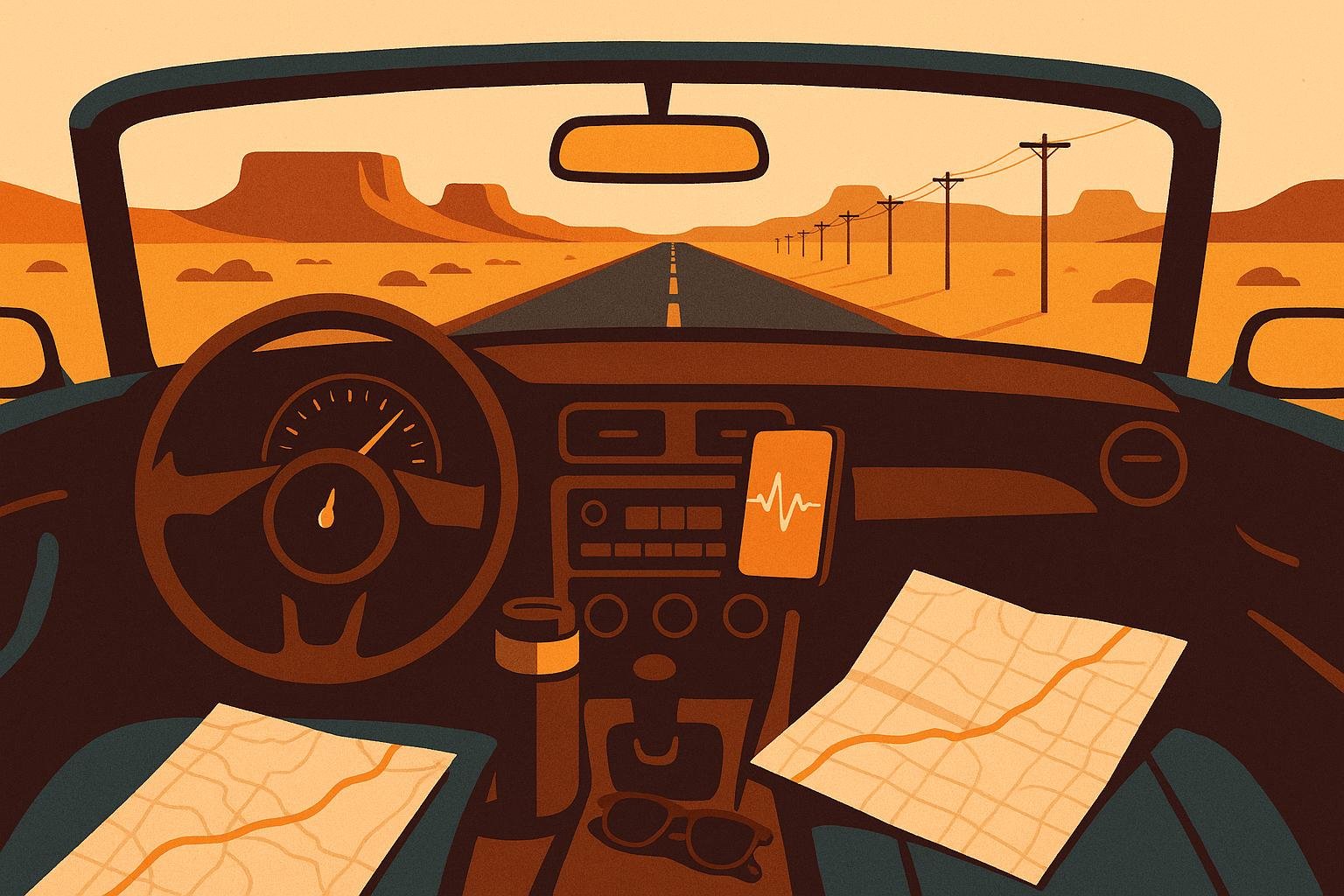
Most 'summer road trip songs' round-ups are just the same 30 tracks in random order. This guide sequences your playlist by trip phase instead — steady highway cruising, singalong rest-stop bursts, and a mellow golden-hour wind-down — using real driving-fatigue research and tempo data to show why structure beats shuffle every time.
Type "summer road trip songs" into any search bar and you'll get the same 30 tracks shuffled into a different order every time. A Beach Boys song, a Smash Mouth song, maybe a Jimmy Buffett song, all dumped into one playlist with zero thought for what happens when you actually press play at mile one. That's the problem with shuffle: it treats a four-hour drive like a random sample instead of an experience with a beginning, a middle, and a sunset.
Why Sequence Beats Shuffle
A 2019 study published in i-Perception put 16 drivers through four real-road driving sessions (no music, slow tempo, medium tempo, and fast tempo) while tracking their brainwaves (EEG) for fatigue and their eye movements for attention quality. The result wasn't a simple "faster is better" or "slower is better." Medium-tempo music was the best overall choice, reducing fatigue while keeping attention sharp across a long drive. Slow tempo gave a short-term attention boost but significantly worsened both fatigue and attention after extended driving. Fast tempo helped with fatigue but hurt attention the longer the drive went on.
In other words, the right tempo depends on when you're listening to it. A playlist that ignores that (thirty songs in whatever order your library spits them out) is working against your own brain for at least part of the trip. Structuring the playlist by phase instead of shuffling it fixes that mismatch on purpose.
Phase One: Highway Cruising (90-110 BPM)
The bulk of any road trip is the boring part: steady speed, straight road, nothing to react to. This is where medium tempo earns its keep. Aim for roughly 90-110 BPM: fast enough to keep your brain engaged, slow enough that it doesn't nudge your foot down on the gas. A steady, chugging rock track like Cold War Kids' "Miracle Mile" fits that mood: propulsive without being frantic, built for a groove you can hold for twenty minutes without thinking about it.
Phase Two: Rest-Stop Energy (120-140+ BPM)
Save the full-volume, fist-pumping energy for when the car is actually stopped, or close to it. Gas station breaks, passenger-seat DJ takeovers, and the last five minutes before you pull into a rest stop are the moment for high-tempo singalong bursts. This is also exactly the tempo range the carwow/SeatPick risk data flags as dangerous at highway speed: Green Day's 186-BPM "American Idiot" and Jay-Z and Alicia Keys' 174-BPM "Empire State of Mind" both scored near the top of the risk index. Good rest-stop songs, not good cruising songs.
No song fits this phase better than Smash Mouth's "All Star." It was built from the ground up to be inescapable: recorded for 1999's Astro Lounge with producer Eric Valentine after Interscope's A&R team sent the band back to the studio because the album, in their view, lacked a single big enough to hit. Guitarist Greg Camp's surf-lounge songwriting plus that mandate for a hit produced a chorus engineered for shouting along, which is precisely why it belongs at a gas station, not at 70 mph in the left lane.
Genre Quiz
Think you know Rock?
Listen to real song clips and prove it — free, no signup needed.
Phase Three: Golden-Hour Wind-Down (60-90 BPM)
The last leg of a road trip (the sunset stretch, the final hour before you pull into the driveway) calls for mellow, melodic tracks, not a crash back down to silence. The carwow/SeatPick safest-songs list is full of exactly this register: Chris Stapleton's 49-BPM "Tennessee Whiskey," Arctic Monkeys' 68-BPM "I Wanna Be Yours," and the Cranberries' 95-BPM "Linger" all scored near the bottom of the risk index thanks to slow tempos and quiet, mellow tones.
One caution from the fatigue study applies here: slow tempo only helps in short doses. Over a long stretch, it measurably increases fatigue and dulls attention. That's exactly why this phase is reserved for the final wind-down rather than the whole back half of the drive: a deliberate last act, not a nap-inducing hour three.
The Mile-by-Mile Checklist Table
Here's the whole structure as a copy-paste template. Swap in your own songs, but try to keep each phase inside its BPM band.
| Trip Phase | BPM Band | Mood | Example Track |
|---|---|---|---|
| Highway Cruising | 90-110 BPM | Steady, hypnotic, alert — not sleepy | Toto, "Africa" (93 BPM) |
| Rest-Stop Energy | 120-140+ BPM | Explosive, singalong, pit-stop adrenaline | Smash Mouth, "All Star" |
| Golden-Hour Wind-Down | 60-90 BPM | Mellow, melodic, low-volume comedown | Arctic Monkeys, "I Wanna Be Yours" (68 BPM) |
Classic 'Songs About Summer' vs. True Road Trip Songs
Not every song that gets crowned a "song of the summer" is actually a road trip song. Per Wikipedia's rundown of the phenomenon, the title goes to whichever track achieves universal, viral awareness between Memorial Day and Labor Day: a high-energy, catchy, slogan-ready earworm like 1989's "Lambada," 1999's "Livin' la Vida Loca," 2002's "The Ketchup Song," or 2012's "Gangnam Style." That's a popularity contest judged on ubiquity, not on how a song behaves at 75 mph for forty-five minutes straight.
A true road trip song has a second job: it has to hold a tempo, not just a hook. Which is why an old, unlikely candidate can outlast a dozen modern summer anthems. Del Shannon's "Runaway" hit No. 1 in April 1961 and stayed there four weeks, a strange, feral piece of pop built around a Musitron, an early synth-like keyboard that his bandmate built himself, which is part of why it's sometimes called rock's first synthpop No. 1. It's been covered by the Traveling Wilburys, name-checked by Tom Petty, and used as a TV theme decades later, proof that a song with real tempo and craft keeps working on a highway long after its chart run ends, in a way a pure "song of summer" built for one viral season often doesn't.
Did the tempo logic stick?
0/3In a real-road study of 16 drivers, which tempo of music was best at reducing fatigue AND maintaining attention over a long drive?
Del Shannon's 1961 No. 1 hit "Runaway" has been called rock's first synthpop chart-topper because of what instrument?
Smash Mouth's inescapable "All Star" appeared on which 1999 album, produced by Eric Valentine?
Building Your Own Version
The three-phase structure works regardless of genre: it's a tempo rule, not a taste rule. A few guidelines for swapping in your own favorites:
- Check the BPM before you drop a song into a phase. Any streaming app or BPM lookup tool will tell you; don't eyeball it off vibes alone.
- Reserve genuinely slow songs (under 70 BPM) for the final wind-down only. The fatigue research is clear that slow tempo turns against you over a long stretch.
- Watch volume, not just tempo. The safest tracks in the carwow/SeatPick data were quiet as well as mid-tempo. Loudness and speed seem to compound each other's risk.
- Mix genres freely within a phase. A 90-110 BPM highway stretch works whether it's built from our Rock quiz, our Country quiz, or our Electronic quiz. The tempo band is what matters, not the label on the genre. If you've used this same approach before, it's the same logic behind our wedding reception playlist guide and our BPM-based workout playlist piece.
Once you've got your own three-phase playlist built, put your ear to the test. Our Rock quiz pulls from the same era and tempo range as most of the tracks above. See how many you can name from a 30-second clip before the chorus even hits.
Genre Quiz
Think you know Rock?
Listen to real song clips and prove it — free, no signup needed.
Frequently asked questions
What's the best BPM for road trip driving music?
A real-road study of long-distance drivers found medium-tempo music was best at reducing fatigue while keeping attention sharp, and a separate analysis of streaming data put the safest zone around 60-100 BPM. That's why this guide keeps the highway-cruising phase around 90-110 BPM instead of reaching for the fastest song on your phone.
Is it actually dangerous to blast fast music while driving?
It can be. An analysis of 252 popular streaming songs found high-tempo, high-volume tracks like Green Day's 'American Idiot' (186 BPM) and Jay-Z and Alicia Keys' 'Empire State of Mind' (174 BPM) carried the highest risk scores, linked to speeding and tailgating. Save tracks like those for a stopped car or a short rest-stop burst, not sustained highway driving.
What makes a 'song of the summer' different from a true road trip song?
A song of the summer is judged on ubiquity and catchiness: the high-energy track that's inescapable everywhere from Memorial Day to Labor Day, like 'Gangnam Style' or 'Livin' la Vida Loca.' A true highway song also has to hold a steady tempo for miles at a time, which is why not every summer anthem belongs in your cruising phase.
Can slow songs actually make a long drive worse?
Yes, counterintuitively. The same long-distance driving study found slow-tempo music gives a temporary boost in attention, but after an extended period behind the wheel it significantly worsens both fatigue and attention quality. It's best reserved for the final wind-down stretch, not the whole trip.
Sources
- Effect of Music Tempo on Long-Distance Driving: Which Tempo Is the Most Effective at Reducing Fatigue? — National Library of Medicine (PMC)
- Could your driving playlist be doing more harm than good? — Carwow
- The Number Ones: Del Shannon's 'Runaway' — Stereogum
- 'All Star': The Story Behind Smash Mouth's Hit Song — uDiscover Music
- Song of the summer — Wikipedia